IELTS Task 1: Recycling Rates for Four Materials (Line Graph)
Question: Summarise the information by selecting and reporting the main features, making comparisons where relevant.
Dịch nghĩa: Tóm tắt thông tin bằng cách lựa chọn và trình bày những đặc điểm chính, đồng thời đưa ra những so sánh khi phù hợp.
Phân tích:
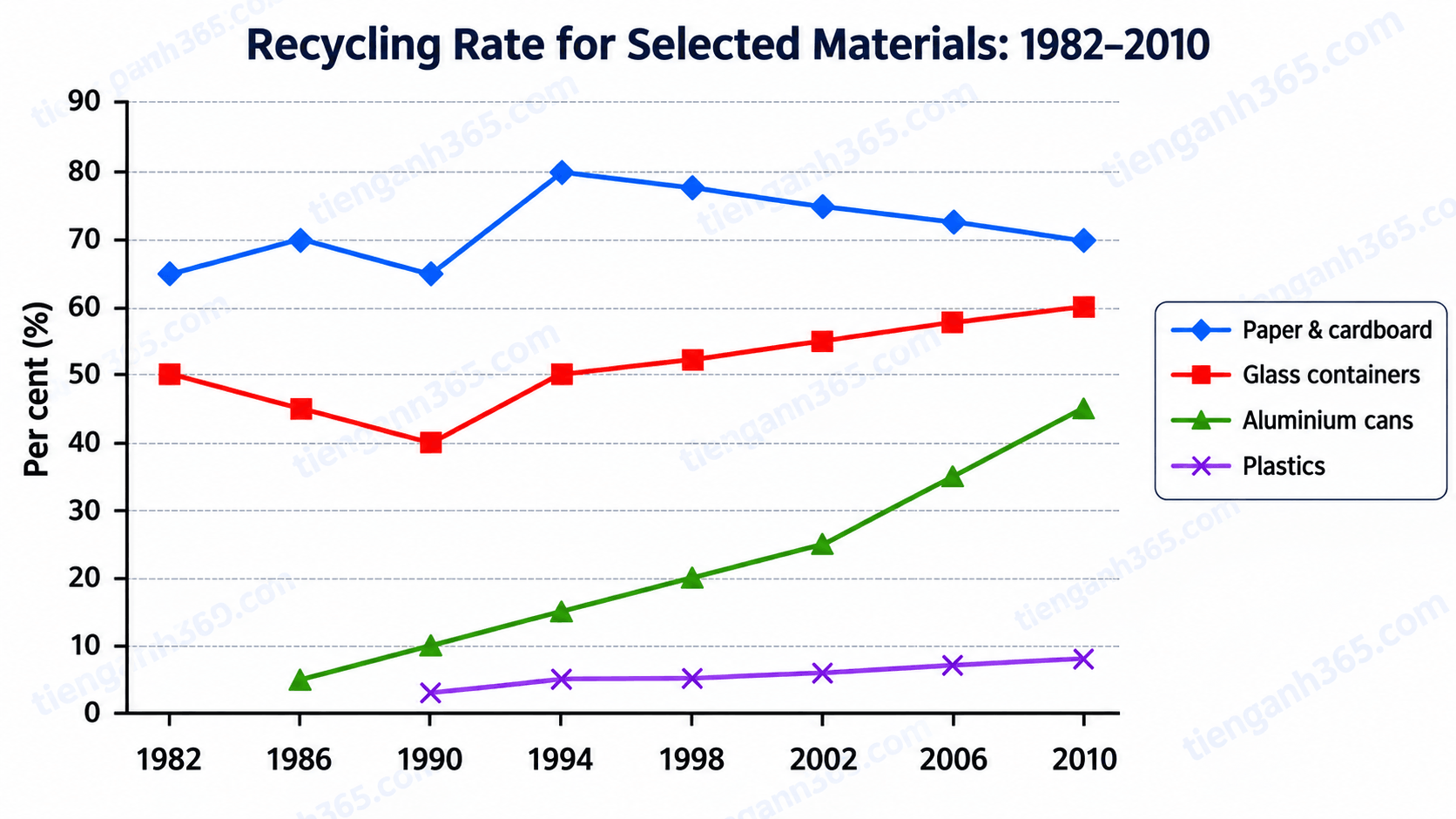
Đây là dạng Line Graph, mô tả sự thay đổi của tỷ lệ tái chế đối với bốn loại vật liệu gồm giấy và bìa, chai thủy tinh, lon nhôm và nhựa. Biểu đồ thể hiện dữ liệu trong giai đoạn từ năm 1982 đến năm 2010.
Đơn vị đo là phần trăm (%). Có bốn đối tượng cần so sánh, tuy nhiên không phải tất cả đều có dữ liệu từ cùng một thời điểm. Trong phần Overview, cần nêu rõ rằng giấy và bìa luôn có tỷ lệ tái chế cao nhất trong suốt thời kỳ mặc dù giảm nhẹ sau khi đạt đỉnh, trong khi nhựa luôn thấp nhất.
Ngoài ra, lon nhôm ghi nhận mức tăng mạnh nhất, còn chai thủy tinh giảm ban đầu rồi phục hồi ổn định vào cuối giai đoạn. Body Paragraph 1 nên mô tả giấy, bìa và thủy tinh vì hai nhóm này có tỷ lệ cao. Body Paragraph 2 tập trung vào lon nhôm và nhựa để làm nổi bật sự khác biệt về tốc độ tăng trưởng.
Bài mẫu tham khảo:
The line graph compares the percentages of four different materials that were recycled between 1982 and 2010. It illustrates changes in recycling rates for paper and cardboard, glass containers, aluminium cans and plastics over the period.
Overall, paper and cardboard recorded the highest figures throughout the period, despite a slight decline after the mid-1990s. By contrast, plastics remained the least recycled material, while aluminium cans experienced the fastest growth. Paper and cardboard stood at around 65% in 1982 before reaching a peak of 80% in 1994. After that, the figure declined gradually to approximately 70% by 2010. Glass containers started at 50%, then fell to 40% in 1990 before recovering steadily to 60% at the end of the period. Aluminium cans first appeared at about 5% in 1986 and rose consistently to 45% by 2010.
This represented the most dramatic increase among all four materials. Meanwhile, plastics remained relatively stable, increasing only from roughly 3% in 1990 to just under 10% in 2010. Even by the end of the period, its recycling rate was considerably lower than those of the other materials.
Word Count: 180 words
Estimated IELTS Band: 8.0
Từ vựng:
| Useful Phrase | Nghĩa tiếng Việt |
|---|---|
| recorded the highest figures | ghi nhận mức cao nhất |
| remained the least recycled material | vẫn là vật liệu được tái chế ít nhất |
| experienced the fastest growth | ghi nhận tốc độ tăng nhanh nhất |
| stood at around | ở mức khoảng |
| reaching a peak of | đạt đỉnh ở mức |
| declined gradually | giảm dần |
| fell to | giảm xuống còn |
| recovering steadily | phục hồi ổn định |
| rose consistently | tăng đều đặn |
| the most dramatic increase | mức tăng mạnh nhất |
| remained relatively stable | duy trì tương đối ổn định |
| was considerably lower than | thấp hơn đáng kể so với |